Newcomers in the Bow Valley: A Community Profile
This profile represents our best estimates about the current population of newcomers to Canada in the Bow Valley.
According to the 2021 Census of Population (Statistics Canada), there were 7,725 residents born outside of Canada living in the Bow Valley.
The community changes often, and people may move in, move out, or shift between different immigration pathways over time. People may also move between different communities within the Bow Valley. There is no single source that shows exactly how many newcomers are living in the Bow Valley at one point in time.
To build the clearest picture possible, this profile combines:
2021 Census Data from Statistics Canada,
available immigration data from Immigration, Refugees and Citizenship Canada (IRCC), and
local service data from newcomer-serving agencies including Foreign Worker Support Services and Settlement Services in the Bow Valley.
Each source has limits, but together they give us an understanding of who is here, the main newcomer groups in the community, and the trends we need to consider for local decision-making.
Who are newcomers to Canada in the Bow Valley?
The most recent data we have is from Statistics Canada's 2021 Census, which shows that 7,725 Bow Valley residents were born outside of Canada. That is 32.8%, or about 1 in 3 residents (this is based on a semi-custom geography for the Bow Valley region extending from Lake Louise to Kananaskis).
For the purposes of this profile, this data focuses on Foreign Workers, and Permanent Residents of Canada.
Foreign Workers: Temporary residents who can legally work in Canada, for example: Working Holiday permit holders, Young Professional Visa holders, Temporary Foreign Workers (LMIA), Post-Graduation Work Permit holders, International students (with work authorization) and more.
Permanent Residents of Canada (PR): Someone who has immigrated to Canada and has received permanent resident status from the Government of Canada. This group includes people who came through economic, family, and refugee pathways. They are not Canadian citizens but are citizens of another country.
Based on available immigration data, the Bow Valley has at least 2,715 newcomers to Canada across recent data years, including permanent residents, temporary workers, international students, and refugee claimants. This does not include naturalized Canadians - that is, people who were not Canadian citizens at birth, but have been granted Canadian citizenship after living in Canada as a Permanent Resident.
Local services work with a diverse local newcomer population.
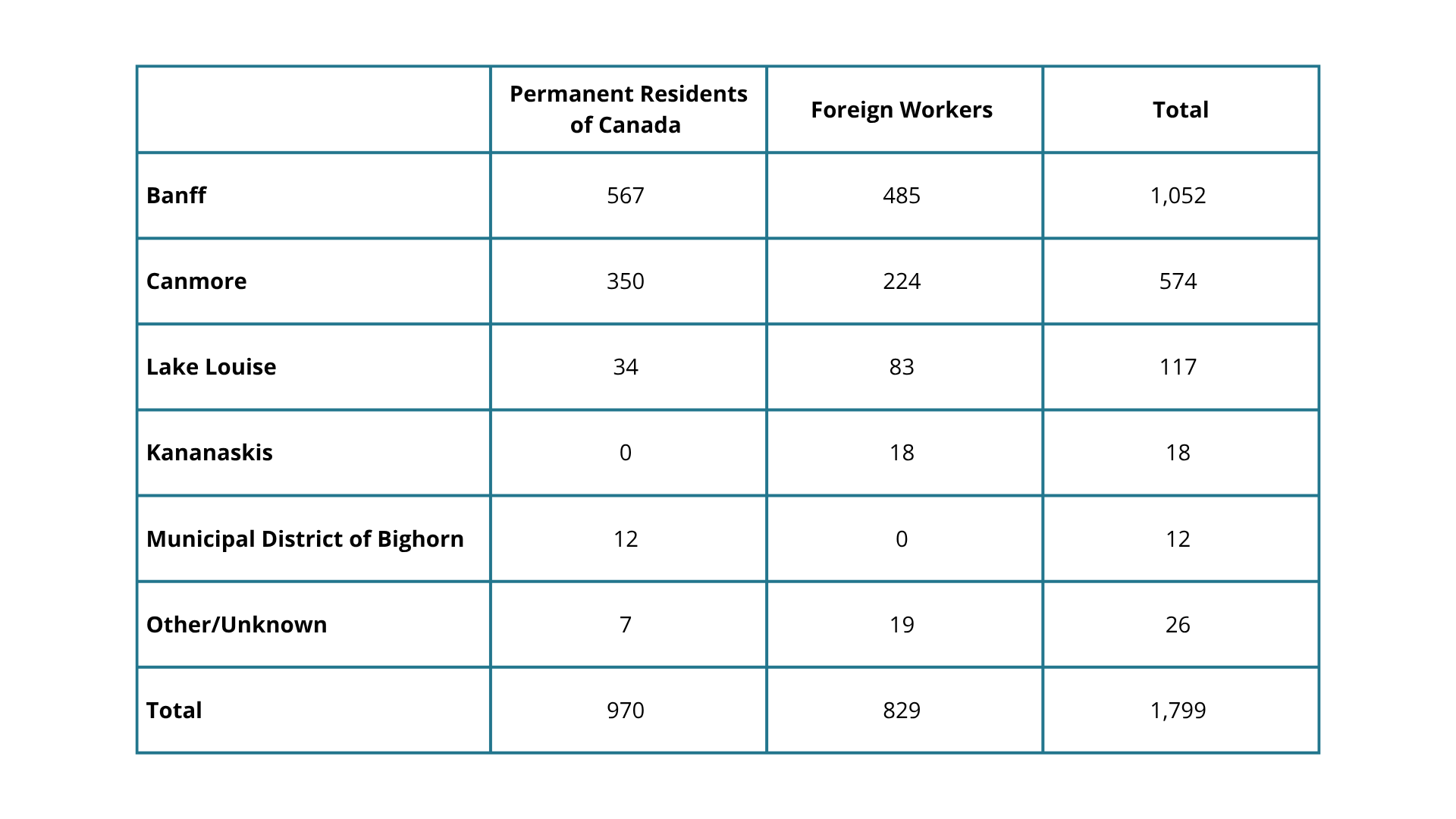
Between April 2025 - March 2026, Foreign Worker Support Services, and Settlement Services in the Bow Valley supported 1,799 newcomers to Canada.
If you are a Foreign Worker or Permanent Resident of Canada, you may be eligible for free local support, programs, and activities to help you live your best life in Canada.
The Bow Valley is a vibrant, multicultural community.
Based on local service data between April 2025 - March 2026, newcomers clients in the Bow Valley came from at least 65 countries of origin.
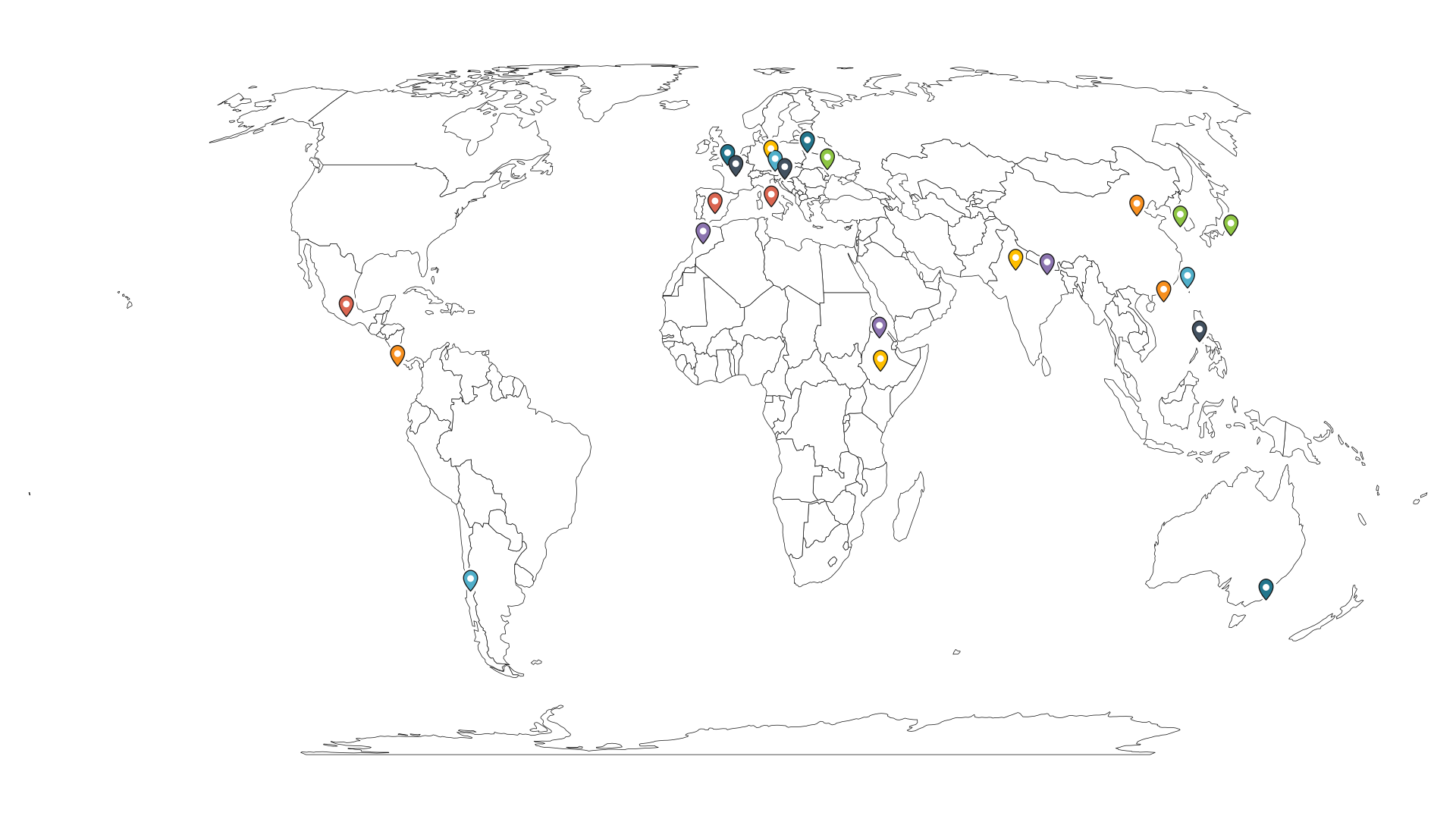
This map was generated using artificial intelligence (AI). It is intended for general visual reference only. This map represents the top countries of origin for Foreign Workers and Permanent Residents of Canada living in the Bow Valley (not all countries). It was produced using data from local newcomer-serving agencies for clients accessing services between April 2025 - March 2026.
Top countries of origin for newcomers to Canada living in the Bow Valley
Based on local service data, clients came from at least 65 countries of origin with the top countries of origin including:
Philippines
India
Japan
China
Chile
Taiwan
United Kingdom
France
Mexico
Korea
Australia
Germany
Morocco
Hong Kong
Czech Republic
Top countries of origin for Foreign Worker Support Services also include: Nepal, Spain, Costa Rica, Italy, Lithuania, and Slovakia.
Top countries of origin for Settlement Services in the Bow Valley also include: Eritrea, Ethiopia, and Ukraine.
Note about the local Ukrainian community: More than 300 people arrived in the Bow Valley through the Canada-Ukraine Authorization for Emergency Travel (CUAET), a temporary emergency measure that ended in 2023. Many Ukrainians continue to live, work, and contribute to the Bow Valley. Because of changes to federal policy, people who arrived through CUAET and have not transitioned to permanent residency are no longer eligible for IRCC-funded settlement services. As a result, they may not be fully reflected in the local service data used in this profile.
Top languages requested locally for translation and interpretation
Local newcomer-serving agencies reported receiving the most requests for translation (written language) and interpretation (spoken language) services in the following languages, - in alphabetical order:
Chinese Mandarin (Traditional) / 中文(繁體)
French / Français
Japanese / 日本語
Spanish / Español
Tigrinya / ትግርኛ
Ukrainian / українська


Snapshot: Foreign Workers
BVIP estimates that in 2025, the Bow Valley community included 2,009 Temporary Workers (projection based on IRCC permits 5-year averages).
Local service data suggests a younger, strongly workforce-linked newcomer group, not only a short-term one.
Many foreign workers appear to be living in Canada for multiple years and may need support that reflects longer-term community presence, not just immediate job-related needs.
Clients served: 829 individual clients
Age: Most aged 25-34 years: 455 clients (54.9%)
Main locations: Banff (485), Canmore (224), and Lake Louise (83).
Most have been in Canada for more than 3 years: 437 clients had been in Canada 37 to 60 months, and 233 for more than 60 months, showing that many are not newly arrived and are building lives here.
Most were in the International Mobility Program: 457 clients (includes Working Holidays and Young Professionals). 221 clients in the Temporary Foreign Worker Program (LMIA program), 102 on Post-Graduation Work Permits, and 49 others.
Client base is highly diverse: Services reached people from 65 countries of origin. Top countries included Chile, Philippines, Taiwan, India, United Kingdom, Australia, Czech Republic, France, Nepal, Mexico, Japan, and China
Trends: The agency noted fewer workers bringing spouses and children, and some dependents leaving Canada due to changes affecting open work permits for family members.
Snapshot: Permanent Residents of Canada
Community-level immigration data from IRCC shows the Bow Valley continues to welcome a steady number of new permanent residents each year. Between 2015 and 2025, annual arrivals ranged from 290 to 600. In recent years, the Bow Valley received:
465 new permanent residents in 2023,
525 new permanent residents in 2024,
420 new permanent residents in 2025.
These numbers only count people who planned to settle directly in the Bow Valley. They do not fully capture secondary migration, which is when newcomers first settle somewhere else in Canada and later move here, or when people leave the Bow Valley after first arriving. This type of movement is harder to measure, so the number of permanent residents living in the Bow Valley may be different from the number of direct arrivals.
2025-2026 data from Settlement Services in the Bow Valley suggests a newcomer population that is largely in the core adult years, with a strong family settlement dimension and growing pressure tied to housing, affordability, and longer-term settlement needs.
Clients served: 970 clients
Age: Mostly working adults aged 30-44 years: 483 clients (49.8%). Settlement Services also served 59 children aged 0-14 years, showing that family settlement needs remain important.
Children and families are a clear and important part of the profile: Supported 371 students in local schools, including 119 children of Temporary Residents.
Main locations: Banff (567) and Canmore (350).
Client base is highly diverse: Services reached people from 65 countries of origin. Top countries included the Philippines, Japan, India, Chile, China, Ukraine, Eritrea, Ethiopia, and Taiwan.
Trends: The agency noted fewer new PRs, increased interest in citizenship, renewed secondary resettlement of Ethiopian and Eritrean refugees, and growing affordability pressure on families, especially in Canmore.
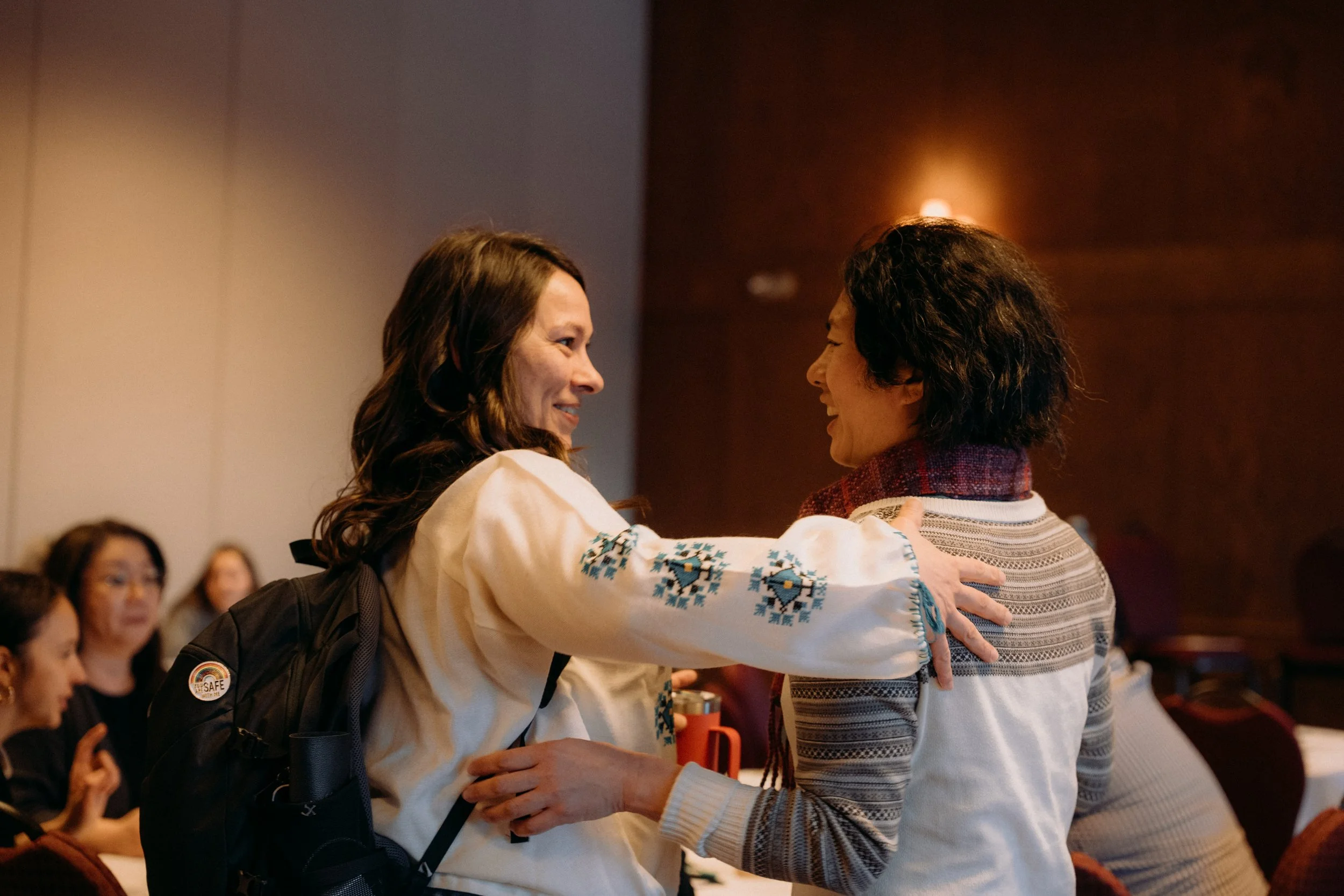

Five key points for the Bow Valley community to know
What does this all mean in practice? Newcomers to Canada have unique stories. When they move to the Bow Valley, newcomers bring with them their rich cultures, languages, experiences. This diversity contributes to a vibrant and welcoming Bow Valley for all.
1) We all have a role to play in creating a welcoming and inclusive community.
Newcomers benefit from accessing specialized services, but their day-to-day experiences are shaped by mainstream organizations like local governments, schools, medical clinics, recreation programs, housing providers, employers, libraries, and local non-profits. Everyone can help build a welcoming and inclusive Bow Valley.
2)Temporary residents are not a small or separate part of the community.
Many foreign workers have been working in Canada for several years. That means mainstream organizations will continue to meet them in schools, clinics, community spaces, and local programs, even if they are not eligible for the same services as permanent residents or citizens.
3) Family needs are an important part of the local picture.
The presence of children, school data, and agency comments about housing, affordability and family stress suggest that newcomer inclusion needs to be considered in child and youth services, family supports, recreation, and school-community connections.
4) Language access matters across the whole community.
The mix of countries of origin and top requested languages shows that plain language, translated information, interpretation, and low-barrier communication matter well beyond settlement agencies. All sectors would benefit from making information more accessible in the languages people feel most comfortable communicating in.
5) Connecting with services early builds confidence and success in Canada.
It is important for newcomers to connect with services as soon as they arrive in the Bow Valley. People often do not know what supports, programs, or information are available until they need help. Early connection can make it easier to learn about housing, schools, health care, work, legal rights, community programs, and daily life in the Bow Valley. It can also help prevent small issues from becoming bigger problems or crises later on.
How we gathered the data for this profile
This Bow Valley community-level immigration data in this snapshot includes information from the following sources:
Immigration, Refugees and Citizenship Canada (IRCC):
new permanent resident arrivals to the Bow Valley from 2015 to 2025
secondary migration estimates based on immigrant tax-file mobility data
temporary resident flow data for work permit holders and international students from 2015 to 2023
local estimates of refugee claimant arrivals from 2015 to 2025
These figures help show broad trends over time. They do not capture every person living in the Bow Valley at one point in time. Some figures are rounded. Temporary resident data is based on the year a permit became effective, not the full number of people present in the community during that year. Some temporary resident categories may overlap.
Estimates are based on projected newcomer numbers in the Bow Valley. It uses past immigration data and future estimates based on the IRCC Immigration Levels Plan. We calculated future local estimates by looking at the Bow Valley’s share of temporary work permit holders in Canada. To do this, we used the Bow Valley’s average share of all International Mobility Program and Temporary Foreign Worker Program permit holders by averaging the five year period between 2019-2023
Service access data:
The service snapshot is based on residents who accessed Foreign Worker Support Services and Settlement Services in the Bow Valley between April 2025 - March 2026.
The service data does not represent all newcomers living in the Bow Valley. It reflects only those who used these services during that period. You can use it as a picture of service access and visible local need, not a full population count.
Notes on assumptions and limitations:
This data assumes the community will continue to receive a similar number of newcomers - as a proportion of national newcomers - as it has over previous five year periods. This applies to permanent resident immigrants, secondary immigration from elsewhere in Canada, and temporary residents (temporary workers, international students and refugee claimants).
The data here is built from a variety of sources, potentially with slightly different definitions, time periods, and approaches. This adds a potential amount of error and a level of uncertainty.
Projections are simply an estimation of what future scenarios might look like given certain assumptions. They should be used as such.
This assumes that the IRCC Immigration Levels will not change substantially from a policy perspective or in reaction to changing global or national context, and that they accurately estimate the number of actual arrivals in the future. These are inevitably uncertain assumptions and means that the projections are rough estimations only.
Bow Valley Newcomer-Serving Agencies
The Bow Valley has free, local programs to support many Bow Valley community members who were born outside Canada. Learn more below.
Foreign Worker Support Services is a free local program, delivered in partnership with CCIS and Town of Banff.
They support foreign workers in the Bow Valley including work permit holders.
Foreign Workers can receive free support, learn about work permits and visas, employment rights and responsibilities, becoming a permanent resident, wildlife safety, community integration, help with documents and more.
Website: banff.ca/tfw
Email: tfw@banff.ca or Phone: (403) 763-1700
Facebook: facebook.com/ForeignWorkersBowValley
Settlement Services in the Bow Valley is a free local program, funded by Immigration, Refugees and Citizenship Canada.
Their friendly team supports all Permanent Residents of Canada (PR) including refugees.
They are here to help you live your best life in Canada and can help you with questions about free local resources, English classes, housing, taxes, citizenship, family, school, and more.
Website: banff.ca/settlement
Email: ssbv@banff.ca or Phone: (403) 762-1144
Facebook: facebook.com/SSBV.CCBV

Bow Valley Adult Learning Centre is a Community Adult Learning Program, funded by the Alberta Government.
They offer many free and low-cost learning opportunities and pathways, including English language classes, French classes, workplace foundational skills, and more.
Website: bowvalleylearning.ca
Email: info@bowvalleylearning.ca or Phone: (403) 762-8114
Bow Valley Immigration Partnership (BVIP) is a regional community partnership creating a more welcoming and inclusive Bow Valley for all, including immigrants and newcomers to Canada.
BVIP members represent every sector of the community. We work together to shift the whole community towards being more welcoming and inclusive through research, shared planning, and a 4-year strategic plan.
BVIP created this document to help community members better understand the local newcomer population.
Website: bvipartnership.com
Email: team@bvipartnership.com or Phone: (403) 497-4208
Facebook: facebook.com/bvipartnership
If you have questions about this profile, please contact us.